
Influencer Marketing Has Changed. Your Creator Strategy Should Too.
For a long time, influencer marketing followed a fairly predictable formula.
Find a creator with a large following. Send them a brief. Pay them to post. Measure the views. Move on.
But the creator economy has matured, and the way brands approach partnerships needs to mature with it.
Creators are no longer simply audiences that brands can temporarily rent. They can be content producers, trusted experts, community connectors and distribution partners, each bringing something different to a campaign.
That changes the question brands should be asking.
Instead of:
“Which influencer should we hire?”
At Popcorn, we think the better question is:
“What job do we need a creator to do?”
Only then should you start building the creator list.
Creator marketing is becoming an increasingly established part of the media mix.
The Interactive Advertising Bureau projects U.S. creator advertising spend will reach $44 billion in 2026, while nearly half of creator ad buyers now consider creators a “must buy.”
IAB: 2025 Creator Economy Ad Spend & Strategy Report
But increased investment also creates pressure to make better decisions.
At Popcorn, we approach creator campaigns through a simple framework:
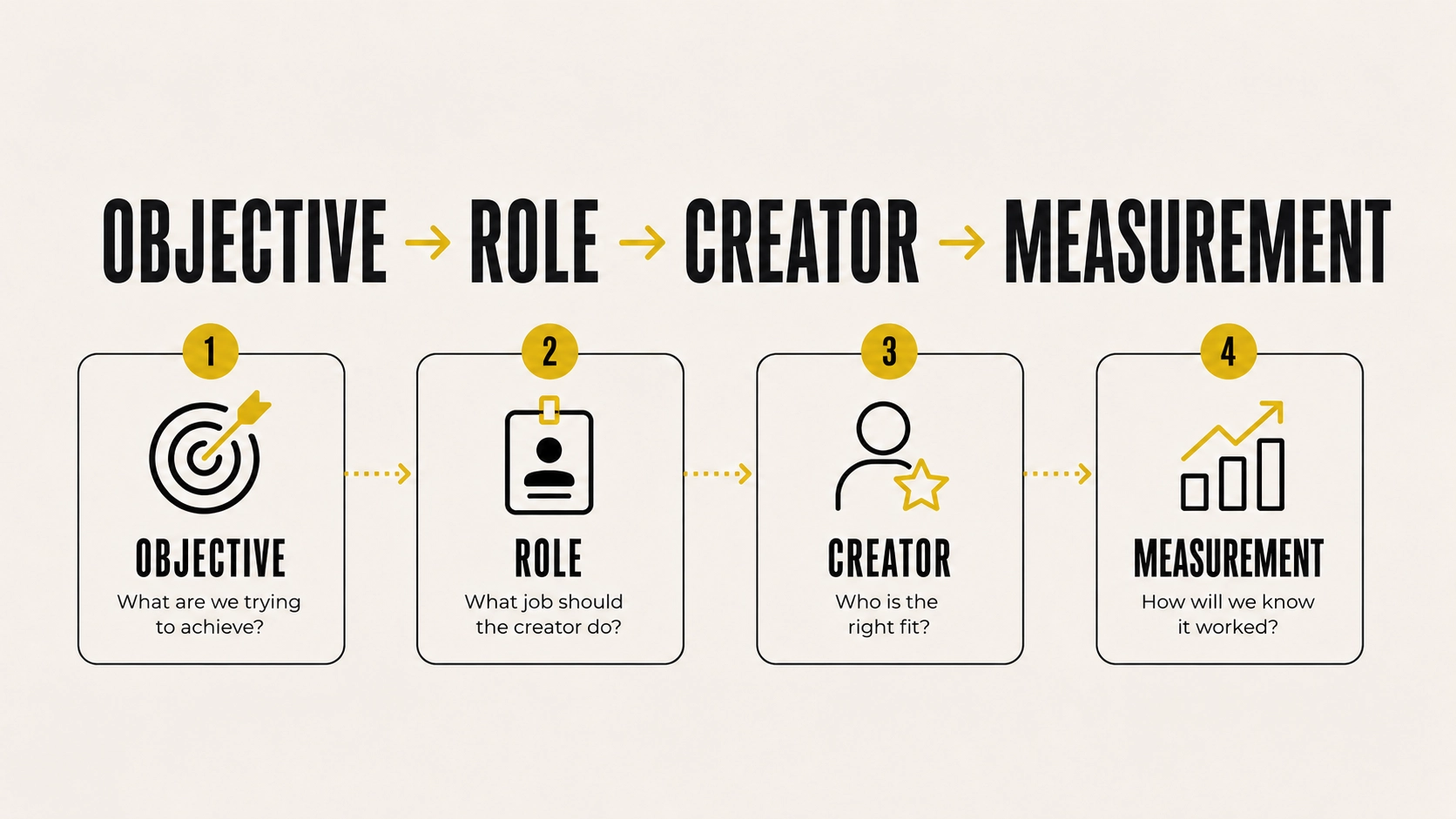
Objective
What does the campaign actually need to accomplish?
Role
What can a creator uniquely contribute to that objective?
Creator
Who has the audience, credibility and content ability to perform that role?
Measurement
What will tell us whether the partnership actually worked?
Changing that order matters.
Too often, brands begin with a spreadsheet of creators and try to build a strategy around them.
We believe the strategy should determine who ends up on the spreadsheet.
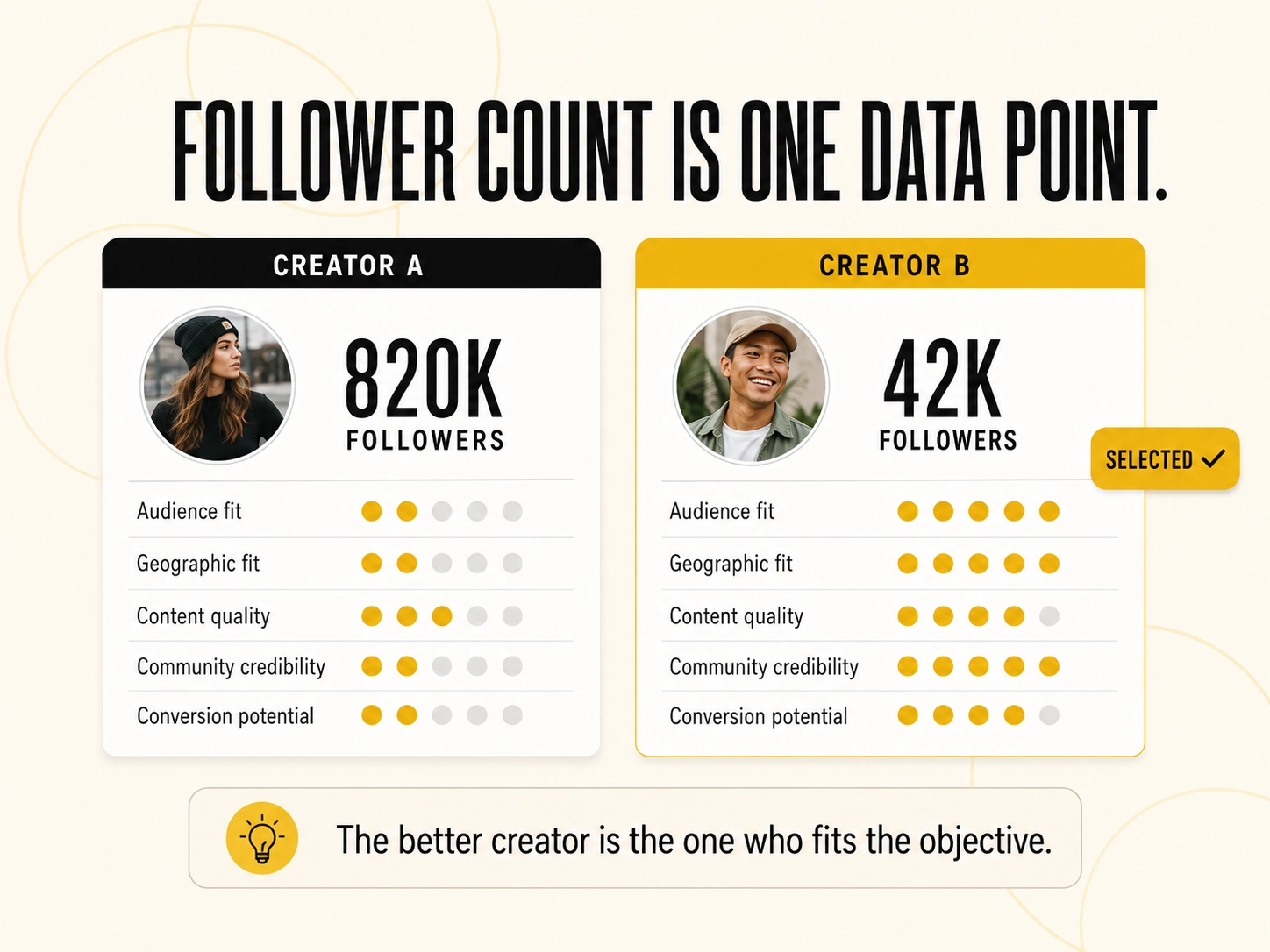
Follower count is easy to understand, which is probably why it has historically played such a large role in creator selection.
A creator with 800,000 followers can look more powerful than someone with 80,000.
But the larger audience is only more valuable if it is relevant to what the brand is trying to accomplish.
Imagine a Vancouver restaurant choosing between two creators.
One has one million followers spread across North America and Europe.
The other has 70,000 followers, many of whom are local and actively follow the creator for restaurant recommendations.
Who actually has more influence for that business?
The answer is not automatically the creator with one million followers.
The same principle applies across categories.
A technical reviewer may be the right creator when a brand needs credibility and product education.
A family lifestyle creator may be more effective when the goal is to show how that same product fits naturally into everyday life.
A gaming creator may communicate a product benefit through gameplay.
A niche community creator may have a smaller audience but far greater relevance.
Same product.
Different creators.
Different jobs.
Different value.
We saw this clearly while developing a Harry Potter creator campaign for HARIBO Canada.
The easy approach would have been to identify lifestyle or food creators with the largest possible audiences.
But this product lived within an established fandom.
Harry Potter fans already have their own references, expectations and relationship with the franchise. That meant the creator needed a believable reason to be part of the conversation.
Our focus was therefore on finding creators who were genuinely connected to Harry Potter and could communicate the collaboration naturally to their communities.
Follower count was still part of the evaluation, but it was not the only factor.
We were also considering:
Why does that matter?
Because there is a difference between someone promoting something and someone who actually understands why their audience would care about it.
For us, that campaign reinforced an important principle:
Relevance is not only about who follows the creator. It is also about whether the creator has a believable reason to be part of the conversation.
Brands also need to move away from looking for the single “perfect influencer.”
We do not expect one media channel to handle every stage of a marketing plan.
A billboard does not do the same job as paid search. An awareness campaign is not measured in the same way as a conversion campaign.
Creators should be approached with the same logic.
Depending on the campaign, you might need creators to provide:
Reach
Get the brand in front of a large relevant audience.
Trust
Bring expertise or credibility to the message.
Content
Produce strong creative that may have value beyond their own feed.
Community
Connect the brand with a specific niche, location or audience.
Conversion
Encourage the audience to take a measurable action.
A campaign may need one of those things.
It may need several.
The mistake is expecting one creator to deliver all of them equally well.
Our work with NETGEAR demonstrates another reason we look beyond vanity metrics.
Technology creator campaigns can quickly become focused on impressive-looking numbers.
Millions of followers.
Millions of views.
Large impression totals.
Those metrics matter, but they do not automatically tell us whether a partnership created meaningful value.
When evaluating creators for NETGEAR, we look at the broader potential return of the partnership.
That means asking questions like:
Two creators with similar follower counts can produce completely different campaign outcomes.
A smaller creator can sometimes be the stronger investment if their audience, creative approach and role within the campaign are better aligned.
That is why we do not treat followers, views or impressions as the definition of success.
They are part of the performance picture.
The more useful question is:
What did we invest, what did the partnership contribute and what did we learn from the result?
That is where influencer marketing starts moving from vanity metrics toward ROI.
There is another shift brands should be thinking about.
A creator is no longer valuable only because of who follows them.
The content itself can also have value.
With the appropriate usage rights, creator content can potentially be amplified through paid media, reposted through brand channels or used as part of a broader campaign.
That means brands should consider two separate questions:
How valuable is this creator’s audience?
and
How valuable is this creator’s content?
The answers may be different.
A creator with a smaller following might be an exceptional vertical video producer whose work performs extremely well when amplified.
Another creator may have an incredibly valuable community but produce content that works best organically on their own channel.
Neither is inherently better.
They are doing different jobs.
This is another reason follower count alone is becoming an increasingly incomplete way to evaluate creators.
If different creators have different jobs, they should not all be measured against the same KPI.
An awareness-focused creator might be evaluated through reach, views and relevant audience exposure.
A community creator might be evaluated through engagement quality, comments, shares and audience relevance.
A content-focused partnership might be evaluated by watch time, creative performance or how the asset performs when amplified.
A conversion-focused creator might be evaluated through clicks, leads, purchases or cost per acquisition.
A creator hired primarily to build awareness should not automatically be declared unsuccessful because they did not generate significant last-click sales.
Likewise, a conversion-focused campaign should not automatically be considered successful simply because the video generated a lot of passive views.
The KPI needs to match the job.
Which brings us back to the framework:
If the objective changes, the creator may change.
If the creator’s role changes, the KPI should change.
And if the measurement does not reflect why the creator was hired in the first place, it becomes difficult to understand whether the partnership actually worked.
Our job as an agency is not simply to find influencers.
It is to understand what the campaign needs, determine the role creators can uniquely play, find the right people for those roles and measure the partnership against what they were actually hired to accomplish.
For HARIBO Canada, that meant prioritizing genuine connection to an established fandom.
For NETGEAR, it means looking beyond vanity numbers to understand how audience fit, creative quality, distribution and performance can combine to generate stronger value from a partnership.
Different objectives require different creators.
That is exactly how it should be.
The creator list should never be the strategy.
It should be the result of the strategy.
The creator economy is becoming more sophisticated.
Brands are investing more. Creators are operating more professionally. Content can extend beyond organic feeds through paid amplification. And audiences are increasingly accustomed to seeing brand partnerships.
As the industry matures, simply paying for access to someone’s following becomes less convincing as a strategy.
Brands need to understand why that person belongs in the campaign in the first place.
At Popcorn, our perspective is simple:
Define the job before you cast the creator.
Do you need reach?
Trust?
Content?
Community?
Conversion?
The creator who delivers the most value may not be the one with the biggest number beside their name.
They are the one who can do the job your brand actually needs done.
Forbes
Traditional Influencer Strategies Need To Change As The Creator Economy Matures
Interactive Advertising Bureau (IAB)
2025 Creator Economy Ad Spend & Strategy Report
CreatorIQ
The State of Creator Marketing Report 2025–2026